

Executive Summary
Timberland values in the U.S. South have appreciated significantly since 2018, driven by increasing capital inflows, decreasing availability and the monetization of alternative revenue streams. This positive trend has been in spite of a sluggish housing market and muted timber prices. MetLife Investment Management (MIM) analysis suggests timberland continues to present attractive investment opportunities, led by resilient land values, portfolio benefits and an increasingly diverse array of alternative revenue sources.
Timberland Market Dynamics
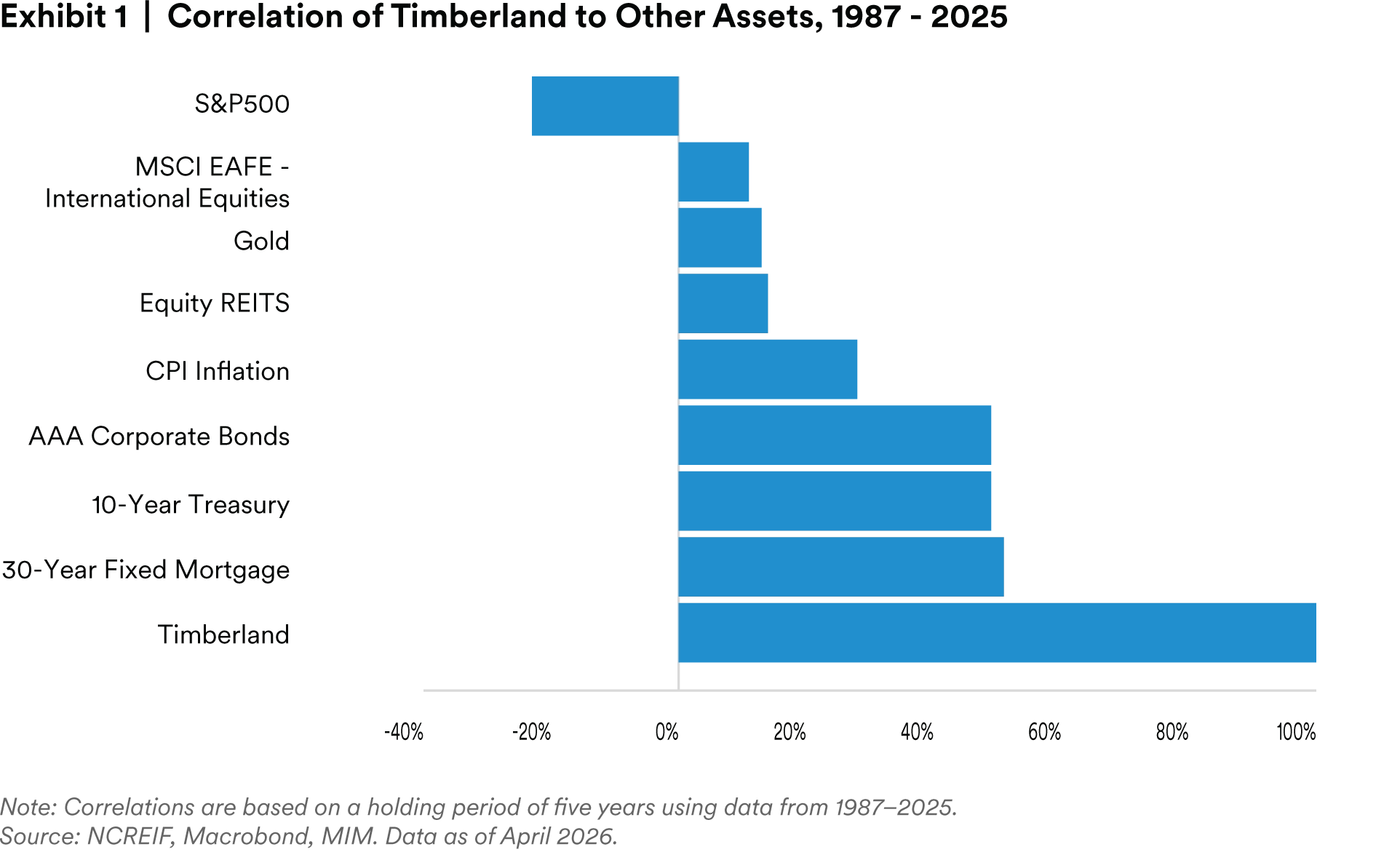
Timberland has a number of characteristics that make it desirable as a capital asset. It preserves wealth across long horizons, generates steady income through periodic harvests and provides embedded optionality due to the flexibility of harvest timing. Further, it increasingly provides a diversity of potential income sources. Timberland also offers low correlations to traditional financial assets and inflation-hedging attributes, which strengthens its role in portfolio construction (Figure 1). While these qualities have been well known to institutional timberland investors for decades, increasing geopolitical risk and macroeconomic uncertainty have reaffirmed their importance, contributing to increased capital inflows.

The limited supply of high‑quality timberland assets has intensified competitive pressures, as rising investor demand has been competing for a small pool of institutional‑grade properties. Challenges around redeploying capital into comparable assets have reduced owners’ willingness to transact, creating a lock‑in effect that limits the available supply and reinforces elevated valuation levels.
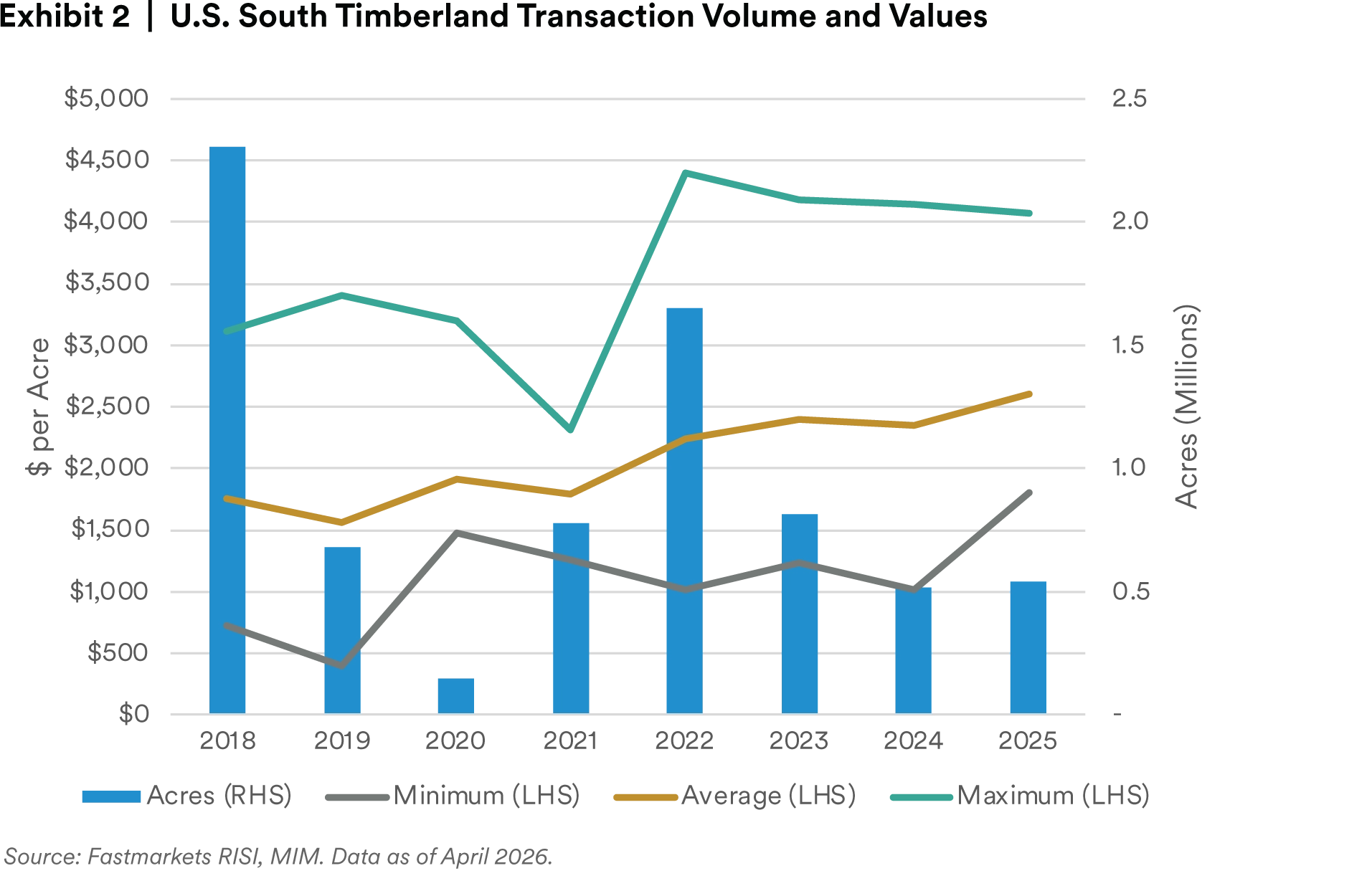
According to Fastmarkets RISI data, institutional timberland transaction prices in the U.S. South have increased by nearly 50% from 2018 to 2025, rising from an average of just over $1,750 per acre to approximately $2,600 per acre (Figure 2). While these averages reflect a mix of property sizes and quality, the upward trend is consistent across most institutional grade transactions.
Optionality and Alternative Revenue Streams
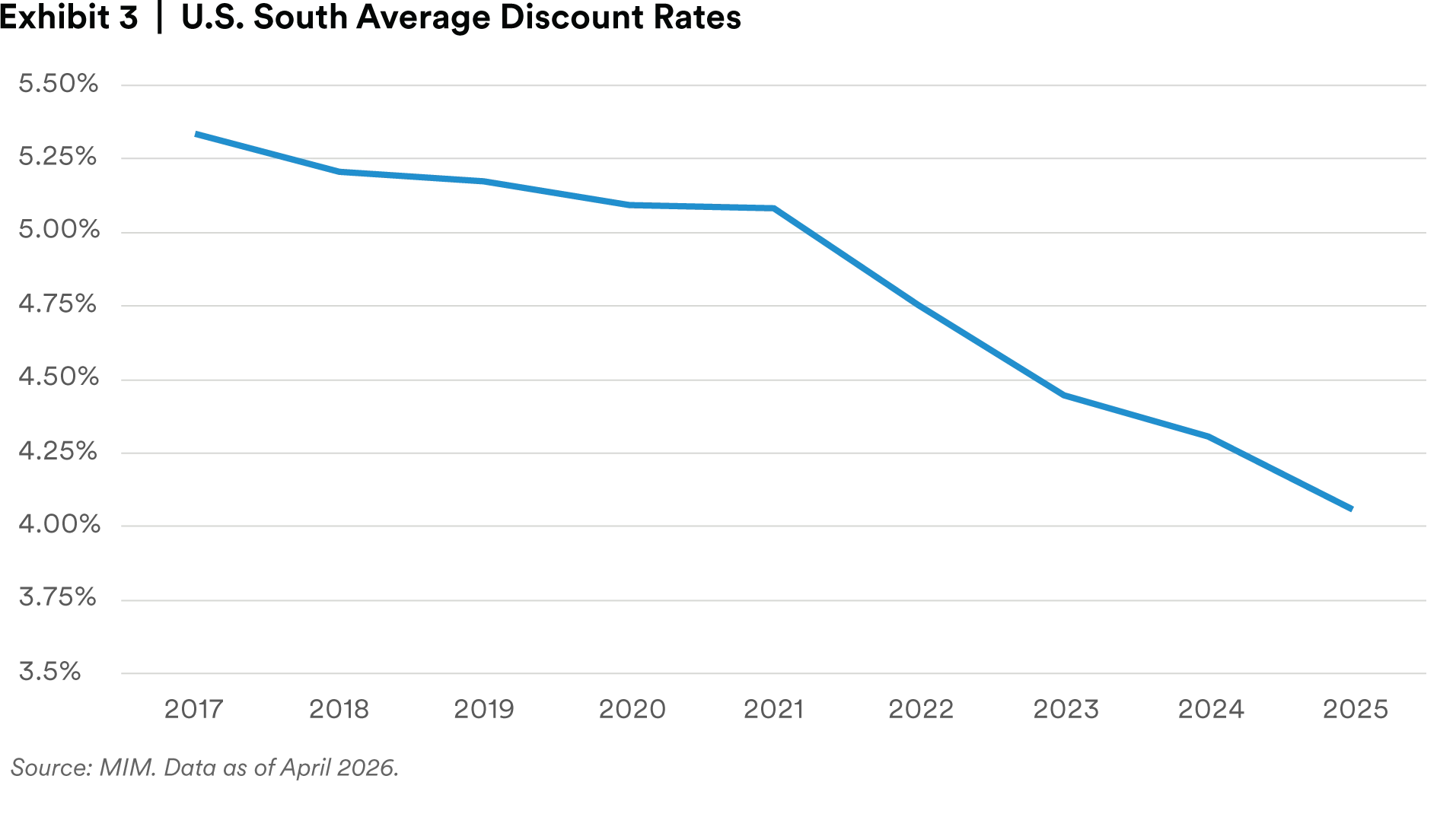
Timberland values are benefiting from an increasingly diverse number of revenue streams. These include carbon sequestration, renewable energy leases and conservation easements, among others. Although acquisition models may incorporate these alternative income sources, appraisers often remain more conservative and primarily or exclusively include timber harvest revenues, particularly when alternative revenue streams are uncertain or highly site specific. To reconcile appraised values with observed market values, appraisers may lower discount rates in income-based approaches — a trend observed within MIM’s internal appraisal data over the last several years. (Figure 3). Because of the possible mismatch regarding which cash flows are considered when valuing a property, we do not believe declining appraiser discount rates indicate a commensurate decline in investors’ required returns. The 2022–2023 period particularly highlights this disconnect, since that was a point in time when broader market interest rates and return requirements were rising.
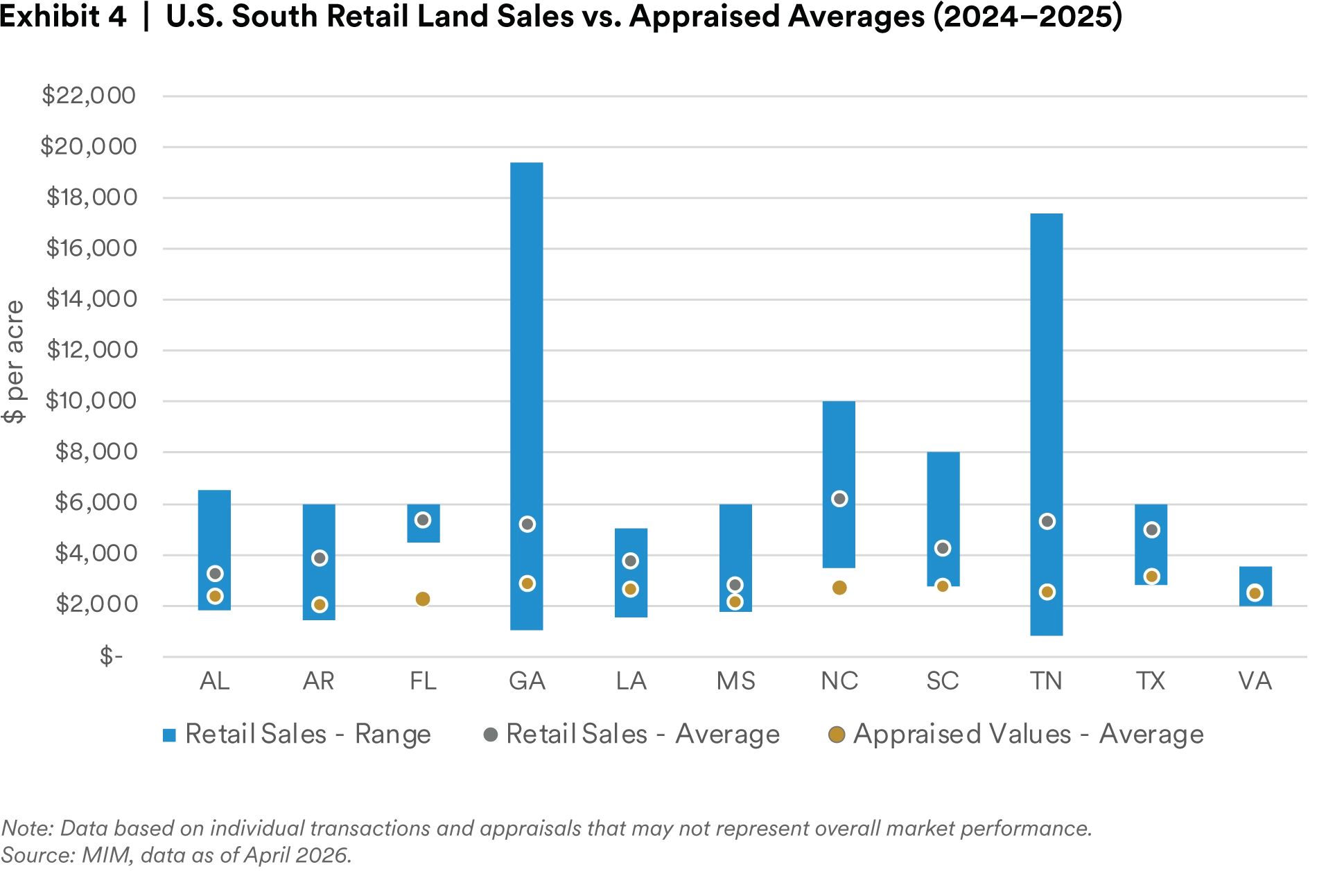
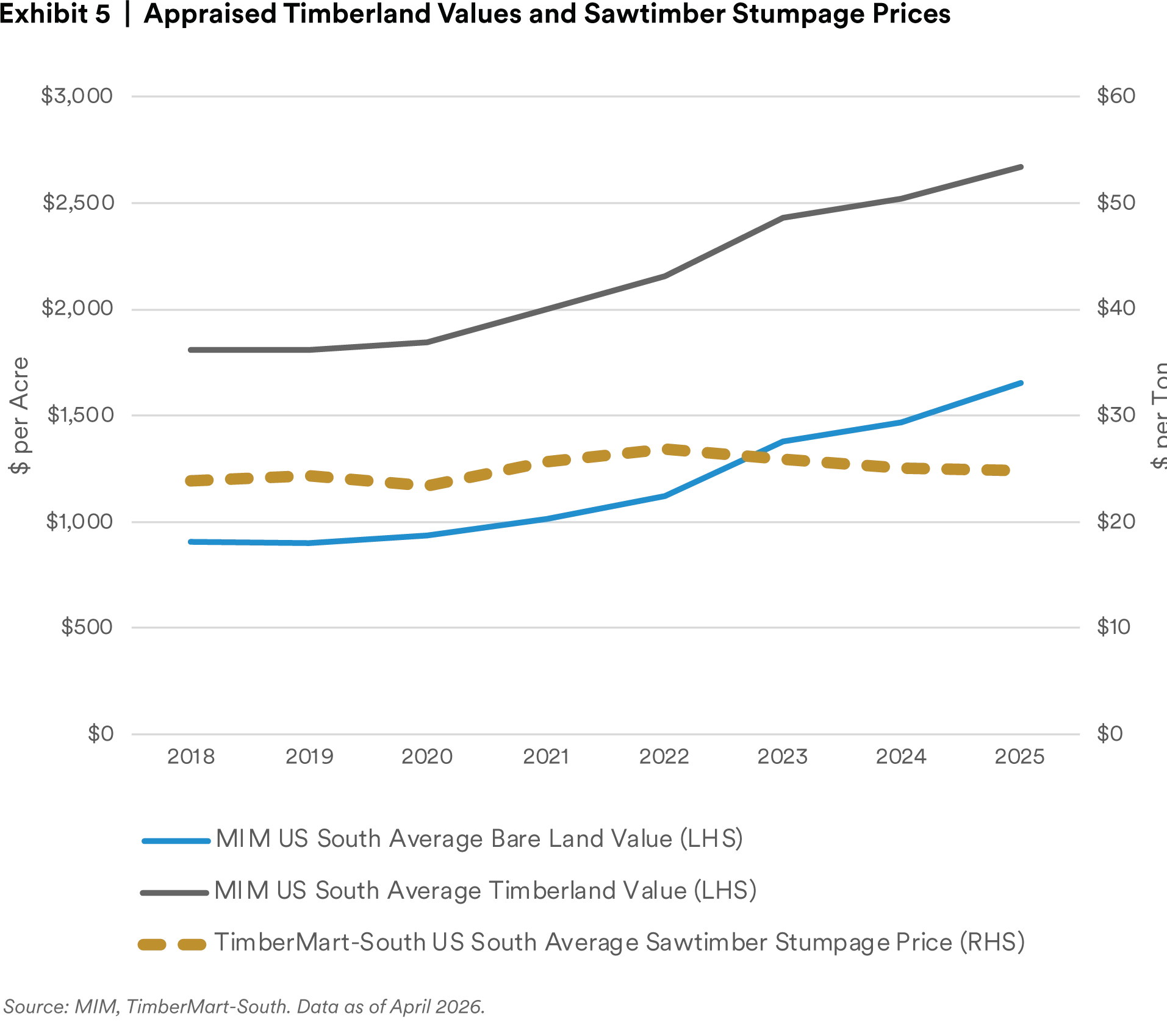
Increasing demand for recreational timberland has created additional opportunities to generate profit through the sale of non core parcels, increasing the optionality embedded in timberland investments. While these dispositions typically represent a small share of the overall land base, they often achieve meaningfully higher per-acre prices than whole tract appraised averages. Figure 4 summarizes nearly $200 million of U.S. South timberland dispositions from MIM’s timberland mortgage portfolio over the past two years, showing the realized per-acre pricing differential relative to average appraised values. The ability to selectively dispose of non strategic acreage to generate cash flow represents a realizable source of land optionality, providing a buffer against weak timber economics and helping explain why an increasing share of total appraised value is being allocated to the land component (Figure 5).
Appraisal data from MIM’s timberland mortgage portfolio indicates that the average per-acre appraised timberland value in the U.S. South has increased by over 45% since 2018, even as sawtimber stumpage prices have remained relatively unchanged (Figure 5). When overall property values rise without a commensurate increase in timber prices, the residual value is typically allocated to land. This allocation outcome is consistent with a market that is increasingly valuing the scarcity and optionality of land, including the ability to capture incremental value through alternative revenue streams and retail dispositions. Accordingly, Figure 5 shows the underlying average per-acre bare land value exclusive of timber has risen by more than 80% since 2018, underscoring that a growing share of total value is being allocated to the land rather than the timber resource.
Outlook and Risk Considerations
Despite a backdrop of near-term challenges, including suppressed housing demand, weak wood product markets, mill closures and ongoing trade disputes, the fundamental investment thesis for timberland remains sound. The asset class continues to offer diversification benefits, capital preservation and the potential for biological growth. Long-term housing market fundamentals suggest a positive outlook for increased wood demand, and the relocation of sawmill capacity to the U.S. South is expected to benefit the region over time. While recent market disruptions have added uncertainty, resilient land values and expanding alternative revenue streams provide support for timberland investments.
============================================================
Disclosure
This material is intended solely for Institutional Investors, Qualified Investors and Professional Investors. This analysis is not intended for distribution with Retail Investors.
This document has been prepared by MetLife Investment Management (“MIM”), which is MetLife Inc.’s institutional investment management business. MIM is a group of international companies that provides investment advice and markets asset management products and services to clients around the world.
This document is solely for informational purposes and does not constitute a recommendation regarding any investments or the provision of any investment advice, or constitute or form part of any advertisement of, offer for sale or subscription of, solicitation or invitation of any offer or recommendation to purchase or subscribe for any securities or investment advisory services. The views expressed herein are solely those of MIM and do not necessarily reflect, nor are they necessarily consistent with, the views held by, or the forecasts utilized by, the entities within the MetLife enterprise that provide insurance products, annuities and employee benefit programs. The information and opinions presented or contained in this document are provided as of the date it was written. It should be understood that subsequent developments may materially affect the information contained in this document, which none of MIM, its affiliates, advisors or representatives are under an obligation to update, revise or affirm. It is not MIM’s intention to provide, and you may not rely on this document as providing, a recommendation with respect to any particular investment strategy or investment. Affiliates of MIM may perform services for, solicit business from, hold long or short positions in, or otherwise be interested in the investments (including derivatives) of any company mentioned herein. This document may contain forward-looking statements, as well as predictions, projections and forecasts of the economy or economic trends of the markets, which are not necessarily indicative of the future. Any or all forward-looking statements, as well as those included in any other material discussed at the presentation, may turn out to be wrong.
All investments involve risks including the potential for loss of principle and past performance does not guarantee similar future results. Property is a specialist sector that may be less liquid and produce more volatile performance than an investment in other investment sectors. The value of capital and income will fluctuate as property values and rental income rise and fall. The valuation of property is generally a matter of the valuers’ opinion rather than fact. The amount raised when a property is sold may be less than the valuation. Furthermore, certain investments in mortgages, real estate or non-publicly traded securities and private debt instruments have a limited number of potential purchasers and sellers. This factor may have the effect of limiting the availability of these investments for purchase and may also limit the ability to sell such investments at their fair market value in response to changes in the economy or the financial markets.
In the U.S. this document is communicated by MetLife Investment Management, LLC (MIM, LLC), a U.S. Securities and Exchange Commission-registered investment adviser. Registration with the SEC does not imply a certain level of skill or that the SEC has endorsed the investment advisor.
About the Authors
David Williams, PhD is Head of Agricultural Research at MetLife Investment Management.
Clayton Winters-Michaud, PhD is an Associate in Agricultural Research at MetLife Investment Management.
Hugh Lentile is Managing Director of Timberland and Forest Products at MetLife Investment Management.
Andrew Carey is Sr. Director of Timberland and Forest Products at MetLife Investment Management.
Brandon Hatchett is Director of Timberland and Forest Products at MetLife Investment Management.
Perry Humphreys is an Associate in Timberland and Forest Products at MetLife Investment Management.
About MetLife Investment Management
MetLife Investment Management (MIM) is the institutional asset management business of MetLife, Inc. MIM manages investments across public and private markets, including fixed income, real estate, agricultural finance, and timberland investments for institutional investors worldwide.
This article has been republished with permission from MetLife Investment Management’s Agricultural Finance group. The original publication can be found at What’s Supporting Timberland Values?